
The Hidden Cause of Fibromyalgia Pain Doctors Are Only Now Starting to Believe
Forty years of treatment. Almost no change in outcomes. A small but growing group of specialists now think they know why — and it isn't in your nerves, and it isn't in your head.

3:47am. That's the time on her phone, again, because it's always around then that she gives up trying to find a position that doesn't hurt and just lies there instead, doing the math on how many hours of sleep she has left before the alarm.
She's tried the wedge pillow. The weighted blanket. The mattress that cost more than her first car. None of it touches what's actually wrong, because none of it was built for what's actually wrong — which, until very recently, nobody could even name.
Her mother had "bad nerves" and was on painkillers by fifty. Her grandmother, the family always said, was "just tired all the time" — decades before anyone had a word for it. Three generations of women in the same family, told three different versions of the same non-answer.

Forty years, three drugs, and almost nothing has changed
Fibromyalgia was formally recognized by the American College of Rheumatology in 1990. Since then, exactly three drugs have been FDA-approved specifically for it — Lyrica, Cymbalta, and Savella — and outcome surveys of long-term patients show something uncomfortable: average reported quality of life for fibromyalgia patients today is not meaningfully better than it was before any of the three existed.
That's not a knock on the drugs. It's a clue. When three different medications, working through three different mechanisms, all produce roughly the same modest, partial, often-fading results — that's usually a sign the mechanism being targeted isn't the real one.
The doctor visits nobody tells you about
Before any diagnosis, there's usually a stretch — often years — of being told it's something else. "Have you tried yoga?" "This is probably stress." "It's likely just perimenopause." One woman we spoke with was told her fatigue was "probably just having a toddler" — her youngest was nine.
By the time most women get an actual fibromyalgia diagnosis, they've already assembled a private, unspoken ledger of everything they tried first:
| Tried | What happened |
|---|---|
| Lyrica | Some relief, but 18 lbs of weight gain and constant brain fog |
| Cymbalta | Helped mood, did almost nothing for the physical pain |
| Savella | Nausea bad enough to stop after five weeks |
| Physical therapy | Helped short-term, pain returned within days of stopping |
| Elimination diets | Months of effort, no measurable change |
| Massage & acupuncture | Temporary relief, $180–$220/month, not sustainable long-term |
None of this is a story about a woman who didn't try hard enough. It's the opposite — it's what happens when you throw everything you have at a problem nobody has correctly identified yet.


It's not your nerves. It's not your muscles. It's the layer between them.
Underneath your skin, wrapped around every muscle, joint, and organ in your body, is a thin, water-rich tissue called fascia. Most people have never heard the word. For decades, most doctors barely thought about it either — medical schools taught it as little more than packing material, the plastic wrap holding your insides in place.
That assumption is starting to fall apart.
That's the mechanism a growing number of researchers now believe is at the center of fibromyalgia: not a malfunction in how your brain processes pain signals, but a physical, touchable change in the tissue those signals are coming from.
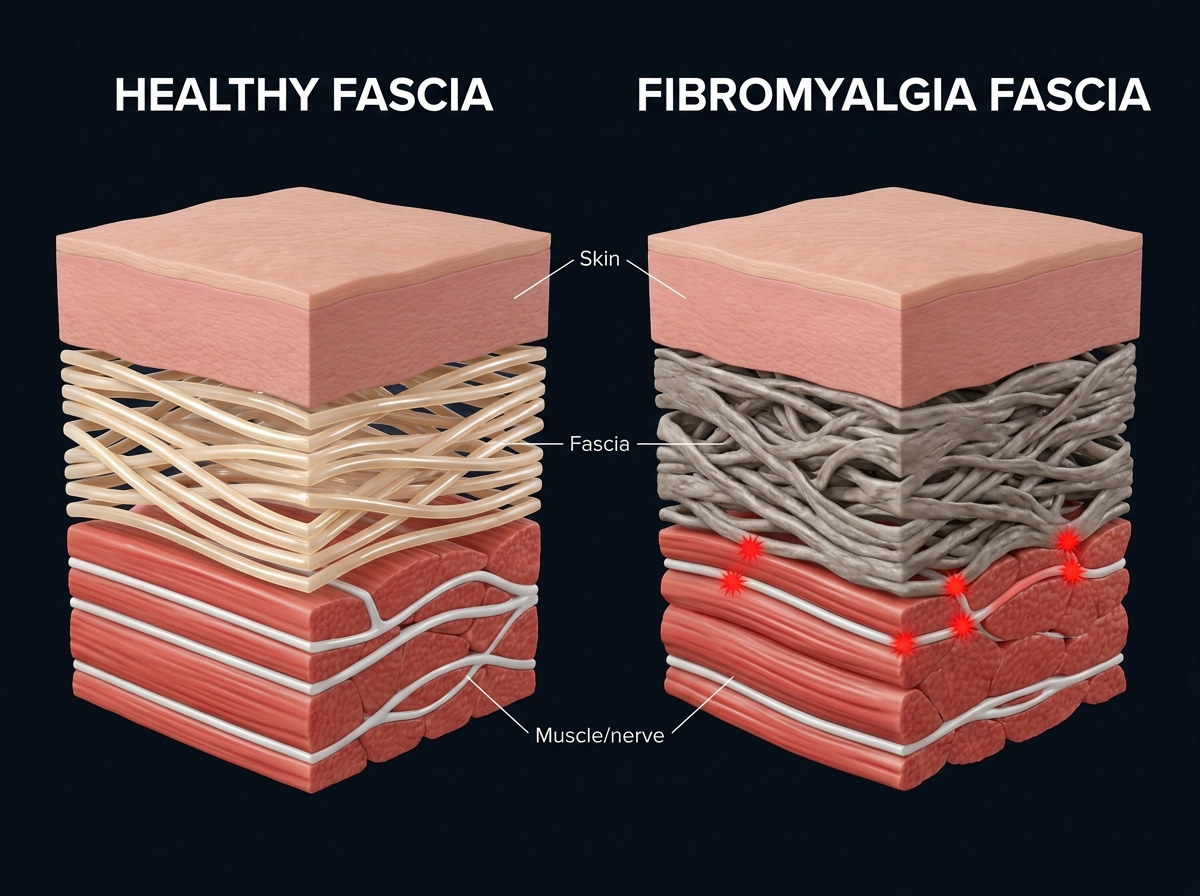
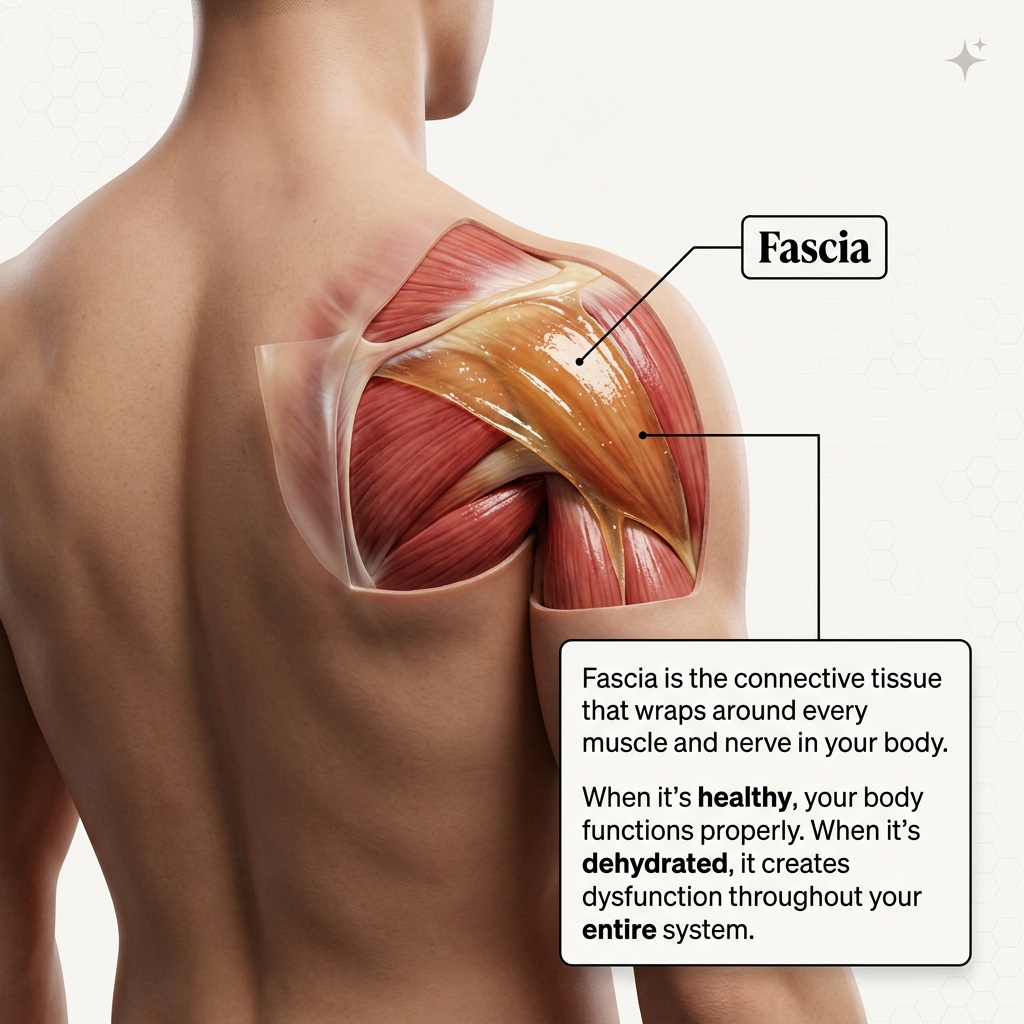
Why doesn't a scan just show this?
Fair question, and one worth answering honestly instead of glossing over. Standard MRI and X-ray are built to find structural damage — torn tissue, degenerated joints, inflammation markers. Densified fascia isn't damaged tissue, it's dehydrated tissue — which is why it doesn't show up on the scans most doctors already have access to. It takes a specific kind of ultrasound elastography, which measures tissue stiffness directly, to actually see it — and that equipment isn't standard in most rheumatology offices yet.
Why this explains so much more than the pain itself
Once you see fascia as the root, the rest of the symptom list stops looking like a random collection of unrelated complaints and starts looking like one problem, showing up in different places:
The widespread pain — dried, densified fascia loses its ability to cushion. Ordinary touch and pressure travel straight through it to the nerve endings underneath, instead of being absorbed the way healthy tissue absorbs it. This is why a light touch that wouldn't register for most people can feel like a bruise.
The brain fog — fascia doesn't stop at your shoulders. Tight, dehydrated fascial bands around the neck and skull base are now believed to restrict blood flow and cerebrospinal fluid movement, which may explain why "fibro fog" so often gets worse on the days the body pain is worst too.
The bone-deep fatigue — moving through stiffened, resistant tissue costs more energy than moving through supple tissue. Researchers describe it as walking through wet sand all day versus walking on solid ground — the exhaustion isn't imagined, it's mechanical.
The "tender points" your doctor pressed on at diagnosis — the 18 classic tender-point locations used in older diagnostic criteria cluster at spots where fascia is naturally thinner and denser to begin with — which may be exactly why densification shows up as pain there first.
Why women are affected at nearly nine times the rate of men
Female fascia is structurally thinner than male fascia — built that way to allow the body to stretch through pregnancy and hormonal change. That same design, researchers now believe, may be part of why it's more vulnerable to densifying in the first place, and why fibromyalgia affects women at such a disproportionate rate. Estrogen also plays a role in how much water connective tissue holds onto — which is part of why so many women report their symptoms shifting around perimenopause, when estrogen begins declining.
Why hasn't anyone told you this?
Fair question. The honest answer is less dramatic than it sounds: fascia research is genuinely new. Serious imaging of fascial tissue in living patients has only been possible for about a decade, and medical curricula move slowly — most doctors practicing today were trained before this research existed. It's less a cover-up than a lag. But the lag is real, and it's cost people years.
There's also, quietly, a financial asymmetry worth naming: there's no patent to file on drinking more water or taking a hydration-supporting supplement, which means there's no pharmaceutical marketing budget behind getting this information in front of you the way there is for a new prescription drug. Nobody is hiding this from you on purpose. Nobody is promoting it either.
What comes up when you search it yourself
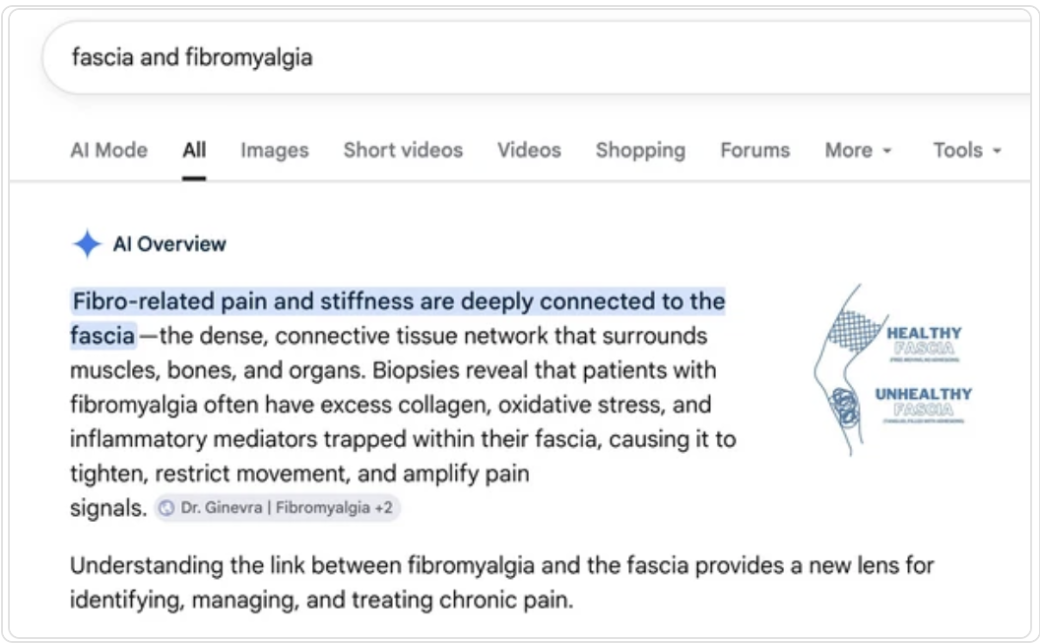
Search results are third-party content, not an Aurelia claim or endorsement — shown here because it's easy to verify this connection is a real, actively discussed area of research, not something we invented.
The 2AM search that changes everything
For almost everyone who eventually finds this research, it happens the same way: alone, late at night, typing increasingly specific questions into a search bar because the daytime answers ran out. "Why does fibromyalgia pain feel worse when I'm dehydrated." "Fascia densification fibromyalgia." "Can connective tissue actually cause nerve pain."
That's usually how it starts — not with a doctor's referral, but with a person refusing to accept that "just manage the symptoms" was the final answer.
What actually rehydrates fascia
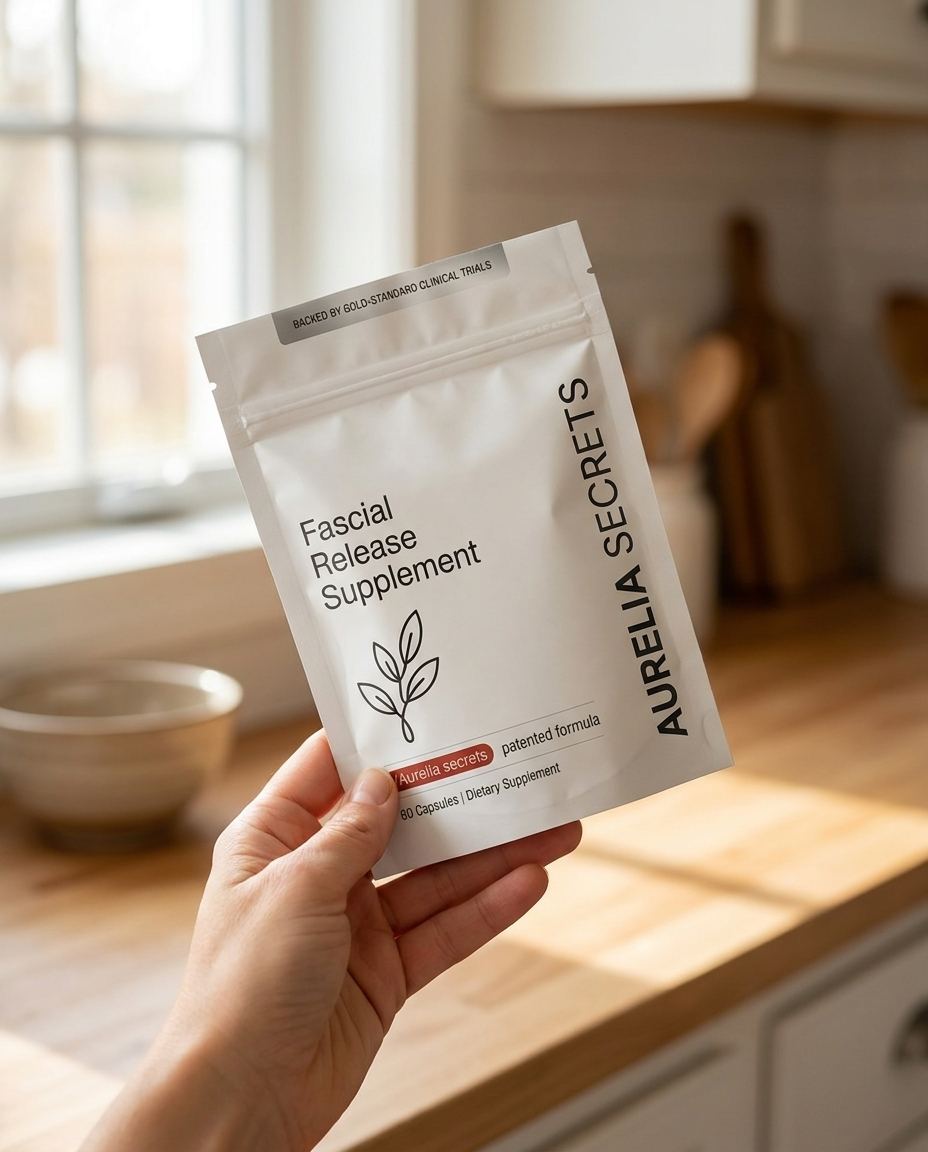
Once researchers identified the mechanism, the next question was obvious: can you reverse it? A small number of compounds have shown up again and again in early research as directly relevant to fascial water content and pliability. This is the exact formula we built Aurelia around.
High-molecular-weight Hyaluronic Acid
The molecule fascia relies on to hold water inside itself — a single gram can bind over a liter of water. Most joint supplements use low-molecular-weight HA, which absorbs faster but holds far less; this is the heavier, slower-release form found in fascial tissue itself.
Bioavailable Silica (bamboo-derived)
The mineral responsible for fascia's elasticity — what allows it to stretch under load and recover afterward, rather than staying rigid.
Serrapeptase
A proteolytic enzyme studied for its ability to help break down excess, hardened tissue buildup — the "grout" itself — rather than just lubricating around it.
Type III Collagen Peptides
The specific collagen subtype most concentrated in fascia (as opposed to Type I, found mostly in skin and bone) — included to directly rebuild the structure the other actives are rehydrating, not just support tissue generally.
Boswellia serrata & bromelain
Studied for supporting the body's normal inflammatory response at the tissue level, without the GI burden associated with long-term NSAID use.
Gotu kola, magnesium glycinate & curcumin
A supporting matrix chosen for circulation and tissue-recovery support — magnesium in particular for its dual role in muscle relaxation and sleep quality, both frequently disrupted in fibromyalgia.

Why she used to need 5 different bottles
Before a combined formula existed, getting all of this meant buying hyaluronic acid, silica, serrapeptase, boswellia, and magnesium separately — five bottles, nine pills a night, doses that didn't match what the research actually studied, and a monthly cost north of $140. Aurelia exists because that shouldn't have to be a second job.
"I spent eleven months and seven formulation attempts trying to get the ratios right before I'd put my name on it. My own patients were the first people to try it."
How Aurelia is different from what's already out there
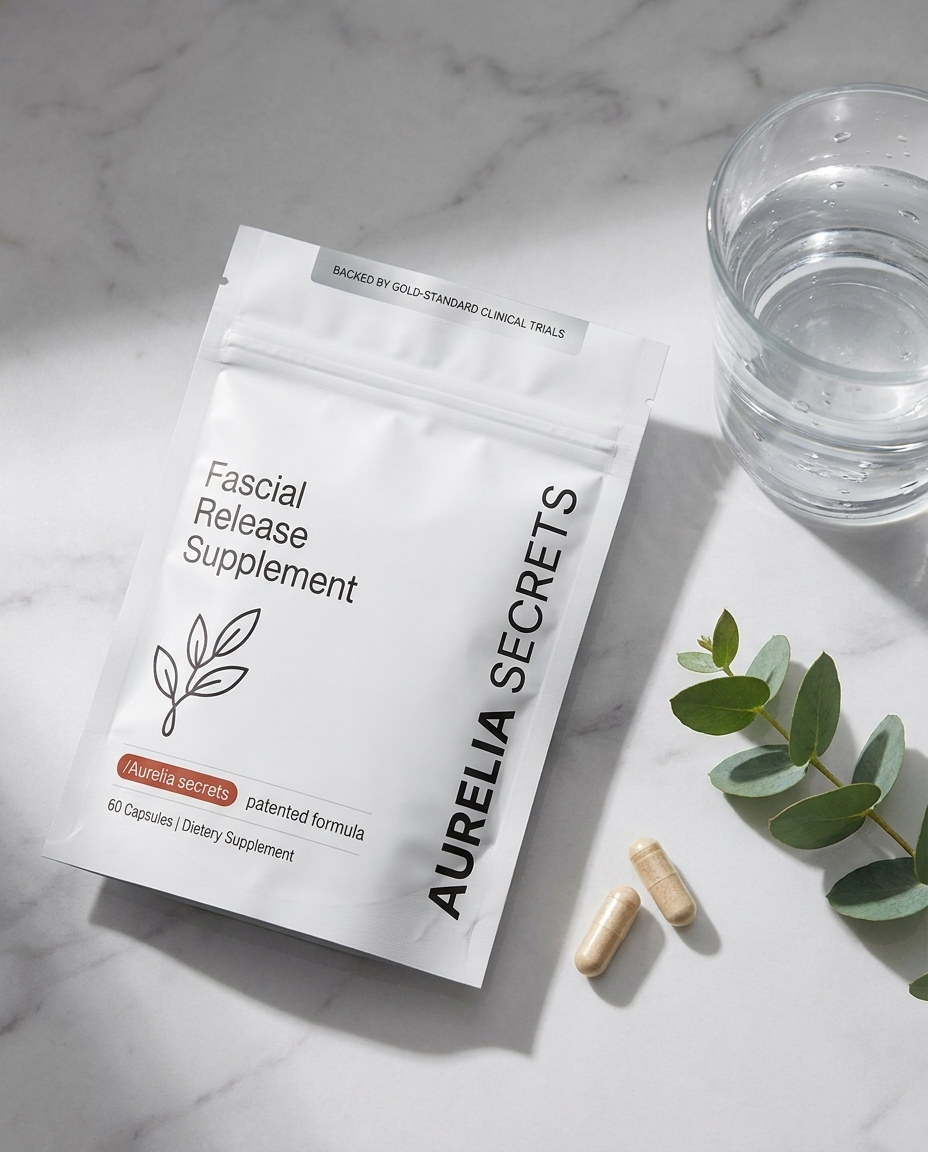
There's at least one other fascia-focused supplement on the market built around a similar three-ingredient core. We started there — and then asked what was missing. The answer was structural support: hydrating and softening tissue is only half the job if you're not also rebuilding it. That's why Type III collagen, the specific collagen subtype fascia is made of, is in the core formula here rather than left out or sold separately.
What 90 days looks like
Based on a self-reported outcomes survey of 900+ verified Aurelia customers with a prior fibromyalgia diagnosis, all of whom had tried at least one FDA-approved medication first. Individual results vary — see full methodology and disclaimer below.
Is it safe with what you're already taking?
Aurelia is formulated to be compatible with the medications most commonly prescribed for fibromyalgia, including Lyrica, Cymbalta, Savella, and low-dose naltrexone. There are no known interactions, and there's no need to stop anything to start. As always, tell your doctor or pharmacist what you're taking before adding any new supplement.
— Dr. Melissa Hartwell, DO
Real stories, not stock reviews


Two different Aurelia customers — not a before/after of the same person.
The guarantee
Try Aurelia for a full 90 days. If you haven't felt a meaningful difference, email us for a full refund — keep the unused product, no return shipping, no restocking fee. We set the guarantee window to match our own outcomes data on purpose: 90 days is when the research says you should know.
Why supply is limited
Aurelia is manufactured in small batches in an FDA-registered, GMP-certified facility in the United States, third-party tested for purity, and fully vegan with no fillers. Small-batch production keeps quality consistent — it also means we occasionally sell out between runs. A portion of every batch is reserved for the clinicians who recommend it directly to patients.

Common questions
- How is this different from a joint supplement?Most joint formulas target cartilage and lubrication at a specific joint. Aurelia targets fascia — the connective tissue layer that runs through your entire body, not just one joint — which is why people report whole-body changes rather than relief in one spot.
- How long until I notice something?Our data shows the earliest reported changes (usually sleep quality) around week 4, with pain-level changes building through week 8–12. Fascia rehydration is gradual by nature — there's no overnight mechanism here, and we'd be skeptical of any product that claimed one.
- Do I need to stop my medication?No. Aurelia is designed to be taken alongside standard fibromyalgia treatment, not instead of it. Talk to your doctor before adding it, as with any supplement.
- Is this the same as the other fascia supplement everyone's seen ads for?No — different formula. Ours adds Type III collagen specifically to rebuild fascial structure, not just hydrate and soften it. See the ingredient breakdown above.
- What if it doesn't work for me?You're covered by the 90-day guarantee — full refund, no questions, keep the product.
P.S. — If you're the kind of person who reads the ingredient panel before anything else: good. Every dose and source above is exactly what's on our label — nothing rounded up, nothing hidden behind a "proprietary blend."
P.P.S. — If you're reading this on behalf of someone you love rather than for yourself: you're not imagining how much this has taken from them, and you're not overstepping by looking into it. The 90-day guarantee applies the same way regardless of who's placing the order.